Skip to contentSkip to footer
Made possible with National Lottery Heritage Fund

Using money raised by National Lottery players, The National Lottery Heritage Fund supports projects that connect people and communities with the UK’s heritage. Vanbrugh 300 is made possible with The National Lottery Heritage Fund. Thanks to National Lottery players, we have been able to develop a nationwide project that aims to broaden the awareness of Vanbrugh through special displays, free education programmes and lectures, throughout his tercentenary year in 2026.
Learn more about the National Lottery Heritage Fund

Welcome to a year-long celebration of Sir John Vanbrugh, England’s finest Baroque architect and dramatist.

Sometimes referred to as ‘The Rockstar of the English Baroque’, Vanbrugh's architectural work was as bold and daring as his early political activism and risqué plays.

This year-long festival will explore how he became the most prominent architect of his time, through events and activities at six of his major country houses and further afield.

Learn more

quote-background-1
“Stair[ing] him in the face. And knock[ing] him down at Once”
(from a letter of 15 September 1720) that describes the effect of the Great Hall at Claremont House on the viewer.
img-original-122

Vanbrugh Life & Times...
1664 - 1726

1681-85
Trade and Travel to India
Vanbrugh started life in the wine trade in 1681, but the firm he worked for went bust, so instead he joined the East India Company as a factor (trading agent). He travelled to India in 1683 to make his fortune at their factory in Surat, Gujarat. However, he was unhappy once there and quickly returned home in 1685.
1685-88
Service in the English Army
Vanbrugh joined the English army in 1685, the first year of the reign of James II, receiving a commission in the Earl of Huntingdon's Regiment. During his military service, he aligned himself with Whig political interests and became involved in opposition to the new king. Vanbrugh left the army and, in the summer of 1688, he travelled to Holland, where he joined those urging the Protestant William of Orange to invade England and claim the throne.
1688-92
Arrested and Imprisoned
While travelling in France in 1688, Vanbrugh was arrested in Calais on suspicion of espionage. He spent the next four years imprisoned in France during the early reign of William and Mary, including a period of confinement in the Bastille, before being released in late 1692 as part of a prisoner exchange.
1693
Return to England
On his return to England in 1693, Vanbrugh moved within a circle of prominent Whig politicians, and he became a member of the Kit-Cat Club, whose gatherings brought together leading politicians and cultural figures. Through the club, Vanbrugh formed connections with influential patrons, many of whom would later commission him to design their country houses.
1696
Restoration Comedy Playwright
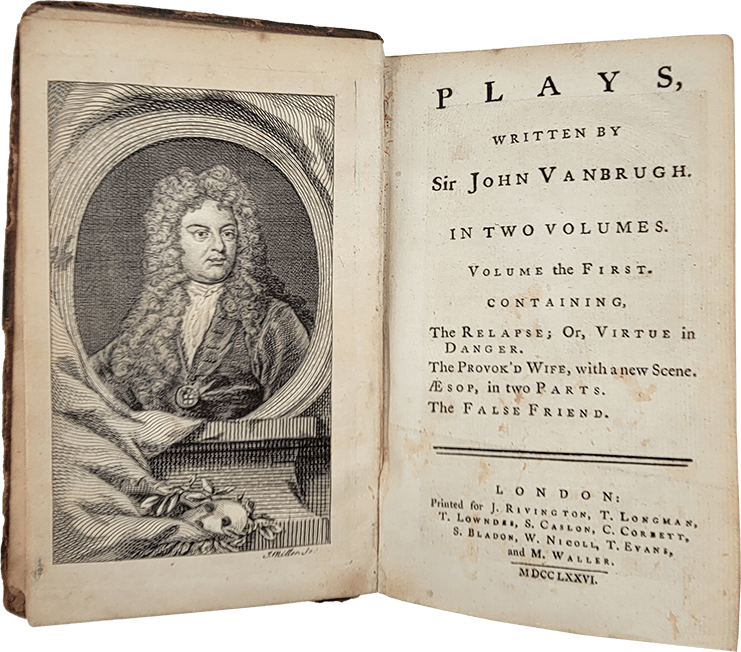
In 1696, Vanbrugh wrote The Relapse, which was staged at the Theatre Royal later that year to great acclaim. Its success led to the production of The Provoked Wife in 1697, a play written earlier, possibly during his imprisonment. Both comedies were celebrated for their wit and boldness, enhancing Vanbrugh's standing among his Whig peers.
1699
Castle Howard commissioned
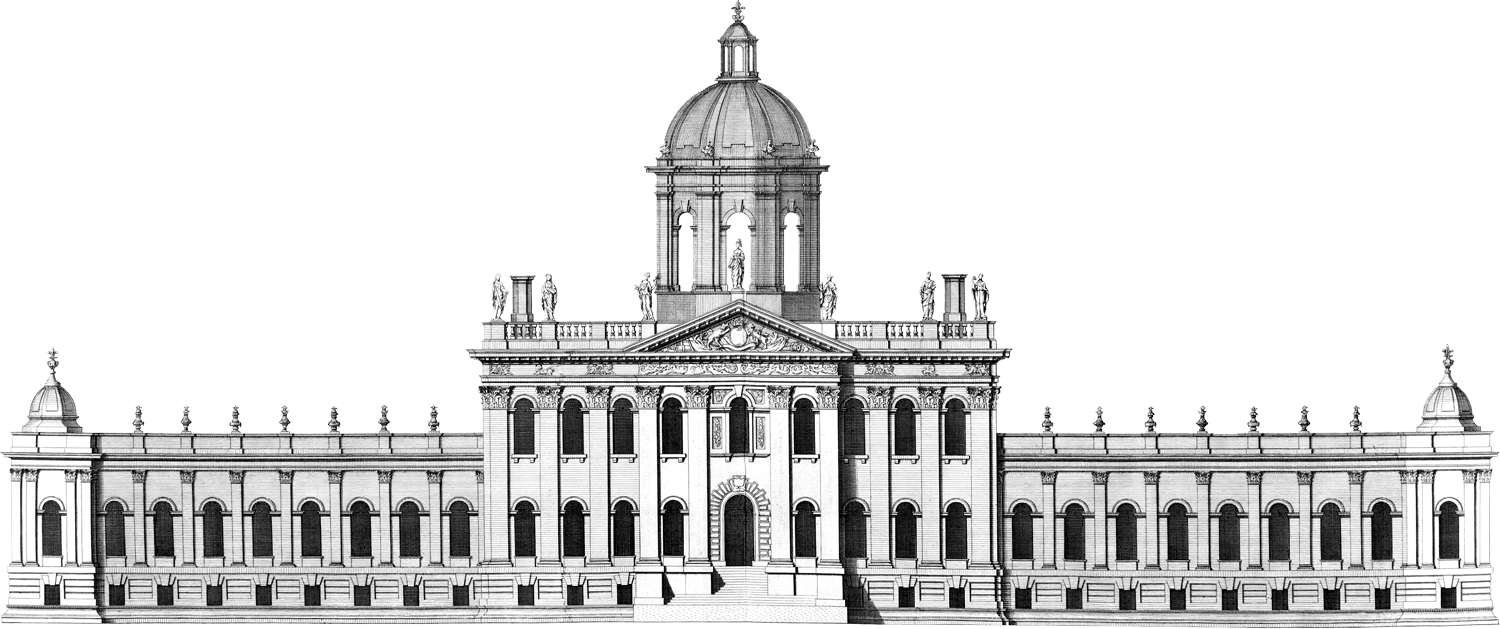
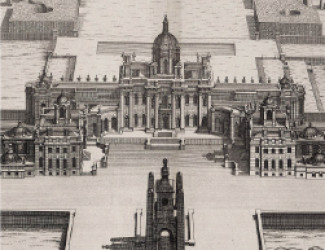
Vanbrugh's first major architectural commission came from his friend and fellow Kit-Cat Club member Charles Howard, 3rd Earl of Carlisle, who entrusted him with the design of Castle Howard in Yorkshire. In the summer of 1699, he toured northern England, visiting recently built country houses, sharing his preliminary drawings, and seeking advice from noble patrons, marking his decisive transition from playwright to architect.
1702-03
Royal Appointment and Public Architecture
In 1702, Vanbrugh was appointed Comptroller of the Royal Works by Queen Anne, marking his formal entry into royal service. The following year, he began designing the Queen's Theatre (later the King's Theatre) in the Haymarket, London, his first major public building and a significant expansion of his architectural career beyond private country houses.
1705
Blenheim Palace Commissioned
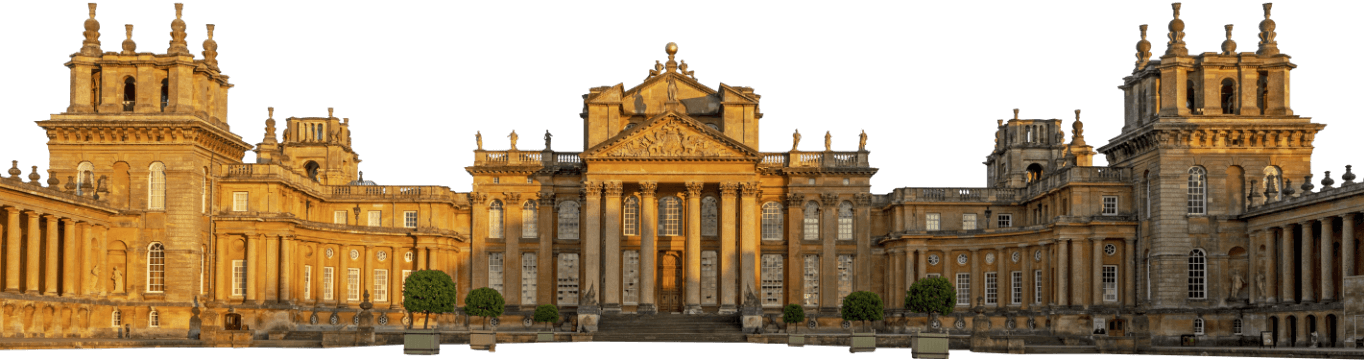
In 1705, Queen Anne commissioned Vanbrugh to design Blenheim Palace in Oxfordshire as a national monument to John Churchill, 1st Duke of Marlborough, following his victory at the Battle of Blenheim. Conceived on an unprecedented scale, the project became Vanbrugh's most famous work but also his most contentious, marked by fierce disputes, particularly with the Duchess of Marlborough.
1707
Kimbolton Castle Redesign
In 1707, after part of Kimbolton Castle collapsed, Vanbrugh and his assistant Nicholas Hawksmoor were asked to redesign the South Front. Vanbrugh proposed an overtly medieval style, giving the building what he called a "castle air" through battlements and austere massing. He later extended this treatment to the rest of the exterior and reorganised the principal rooms.
1714-1715
Knighthood and the Remaking of Grimsthorpe
With the Hanoverian succession in 1714, Vanbrugh was knighted by King George I, becoming the first person to receive the honour in the new reign. The following year, he was appointed Surveyor to the Royal Hospital at Greenwich and Clarenceux King of Arms. In 1715, Robert Bertie invited Vanbrugh to remodel Grimsthorpe Castle.
1716-1718
Vanbrugh Castle
Vanbrugh designed and built Vanbrugh Castle in Greenwich as his own residence. Conceived as a compact, castellated structure, the house reflects his romantic engagement with medieval forms and his taste for dramatic silhouette.
1719-1721
Seaton Delaval Hall and Stowe House
From 1719, Vanbrugh designed Seaton Delaval Hall in Northumberland, his last great country house, personally overseeing the scheme and visiting the site in 1720 and 1721 while delegating construction to the builder William Etty. At the same time, he advised Viscount Cobham on developments at Stowe House, particularly in the gardens, where he designed a series of temples and monuments.
1664
1665
1666
1667
1668
1669
1670
1671
1672
1673
1674
1675
1676
1677
1678
1679
1680
1681
1682
1683
1684
1685
1686
1687
1688
1689
1690
1691
1692
1693
1694
1695
1696
1697
1698
1699
1700
1701
1702
1703
1704
1705
1706
1707
1708
1709
1710
1711
1712
1713
1714
1715
1716
1717
1718
1719
1720
1721
1722
1723
1724
1725
1726

Find out more about Vanbrugh

Explore the venues

Sign up to our newsletter